
The Comprehensive Engineering Guide for Selecting Component and Metallic Structure Manufacturing Techniques
When starting a new project or redesigning an existing product, the design engineer faces a 3D mechanical model filled with intricate technical details. At this moment, the engineering challenge is not limited to choosing the appropriate metal alloys; rather, the fundamental question is: What is the optimal technique to shape this metal and transform it from an engineering blueprint into a physical product?
The world of metal forming stands on two historical pillars representing entirely opposing production philosophies: Subtractive Manufacturing, represented by turning (machining), and Formative Manufacturing, represented by casting.
1.Process Anatomy: What Happens Behind the Scenes?
Turning and the World of Mechanical Machining
The turning process relies on the principle of "controlled removal." The workpiece is fixed onto the main spindle of the lathe and rotated at a high angular speed, while the cutting tool moves in a precise linear motion (parallel or perpendicular) relative to the axis of rotation.
From a materials mechanics perspective, the process boils down to applying a localized shear stress that exceeds the yield strength and shear resistance of the metal. This leads to continuous plastic deformation and separation of the metal in the form of chips. This process is governed by three main dynamic variables determined with utmost precision by the production engineer or CNC programmer:
Cutting Speed: The relative surface speed between the cutting tool and the workpiece, measured in meters per minute.
Feed Rate: The linear distance the cutting tool advances with each full revolution of the workpiece, measured in millimeters per revolution.
Depth of Cut: The perpendicular depth that the cutting tool penetrates into the metal surface in a single pass, measured in millimeters.
Casting and Thermodynamics
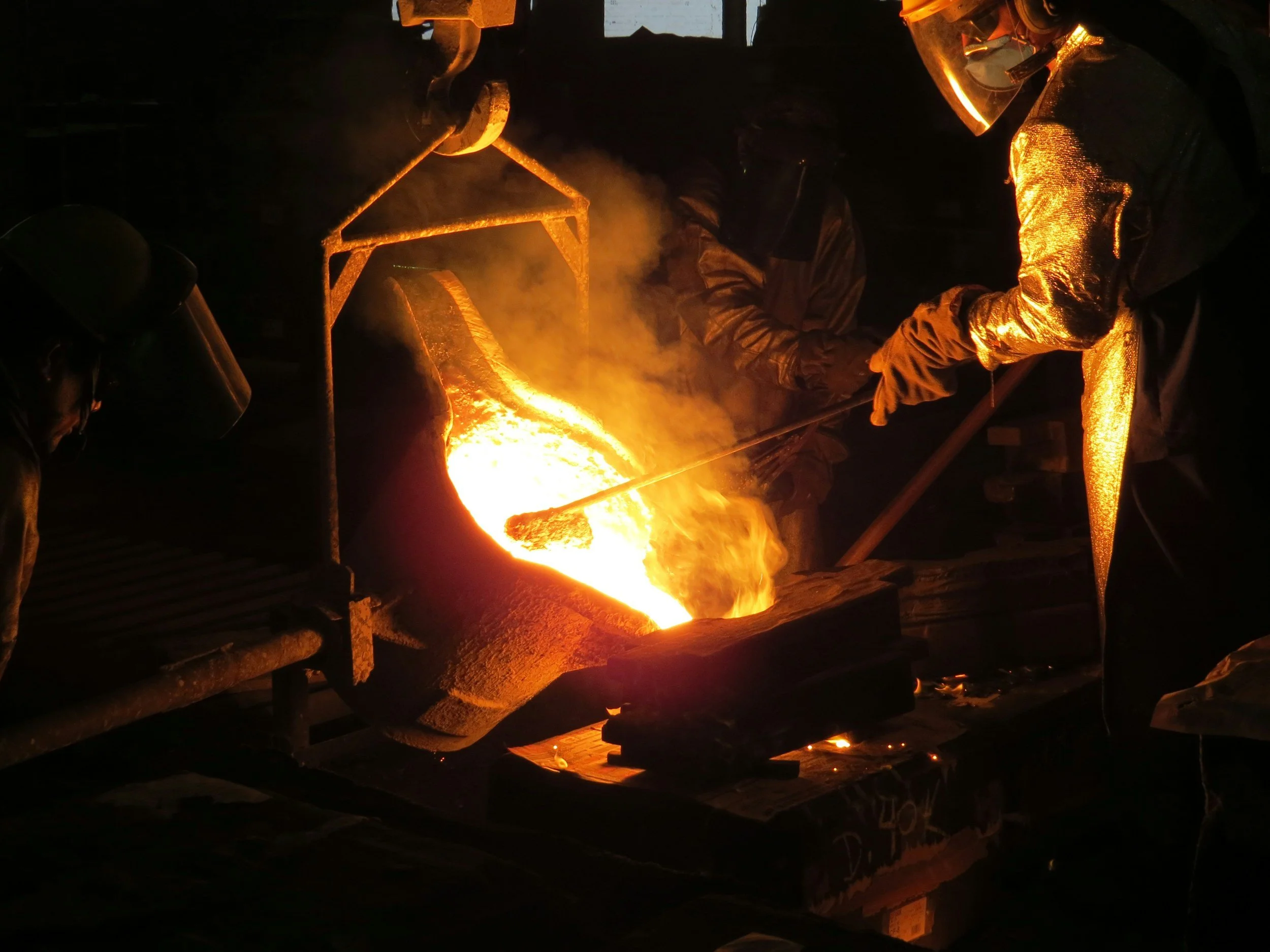
In contrast to turning, casting relies on changing the physical state of the matter. The process begins by converting the metal from a solid to a liquid state by exceeding its melting point, then pouring the liquid which stores thermal energy into a mold cavity to take its shape upon solidification. This process is entirely governed by the laws of heat transfer, fluid mechanics, and phase transformation.
Engineering wise, casting processes are divided into three main types based on the nature of the mold and the materials used in it:
Sand Casting:
It relies on using temporary molds made of sand mixed with clay and chemical binders. It is characterized by a very low initial setup cost, along with high flexibility in producing very large and giant parts. However, its drawbacks include surface roughness, wide dimensional tolerances, and low precision.
Die Casting (Permanent Mold / Pressure Casting):
It is carried out by injecting molten metal under high hydraulic pressure into permanent steel molds (dies). It provides superior dimensional accuracy, excellent surface quality, high smoothness, as well as massive and fast productivity. However, its disadvantages lie in the exorbitant investment costs of manufacturing the molds, and it is mostly limited to non-ferrous metals such as aluminum and zinc.
Investment Casting (Lost Wax):
It is based on producing a wax pattern coated with layers of ceramic, then melting the wax to leave a vacant cavity into which the metal is poured. This technique grants the highest possible geometric precision and the ability to produce highly complex and delicate details, reducing the need for subsequent machining. On the other hand, it suffers from a long, complex production cycle and a relatively high per-part cost.
2. Microstructure and Mechanical Properties
One of the most critical points often overlooked is that the manufacturing method alters the microstructure (crystalline structure) of the metal:
In Turning: We use raw metal previously manufactured via rolling, drawing, or extrusion. This metal possesses a grain structure oriented by hot or cold working processes, giving it very high tensile strength and toughness, and significantly reducing the risk of internal gas porosity compared to cast metals.
In Casting: The metal begins to solidify inside the mold from the outside inward. This cooling creates a random grain structure that may lead to variations in mechanical properties. Furthermore, the shrinkage of the metal during cooling can create micro-defects if the riser is not accurately calculated to compensate for the shrinkage.
3. Comparison of Common Defects and Challenges
Each technique has its own challenges that the engineer must consider in the quality plan:
Common Casting Defects:
Gas Porosity: Trapped air bubbles inside the metal that weaken its strength.
Shrinkage Cavities: Voids formed in the center of the part due to the edges solidifying before the core.
Cold Shuts: Lines of weakness formed when two streams of molten metal meet but fail to fuse completely due to a drop in temperature.
Turning Defects and Problems:
Chatter (Vibrations): Instability of the cutting tool leads to waves on the surface, ruining the smoothness and accuracy of the workpiece.
Residual Stresses: High heat and shear forces resulting from cutting can store internal stresses within the surface, leading to warping later on.
Tool Wear: Continuous wear of the cutting tool requires periodic monitoring to maintain dimensional consistency.
4. Cost Balance and Production Volume
Industrial decisions are often settled by the language of numbers. The economic equation here is very clear:
Turning and CNC: It has a low setup cost but a high per-part cost. If you want to produce 5 or 50 parts, turning is cheaper because you don't need to design and build expensive molds; just buy the raw material and start machining immediately.
Casting: It has a massive initial setup cost for manufacturing steel molds, but the cost per part afterward is negligible. If your production volume exceeds thousands of parts, the mold cost is amortized across the total, making casting the only economic choice.
5. Decision Matrix: When to Choose What?
Geometric Shapes Compatibility
Turning and Machining: Excellent for cylindrical shapes, rotationally symmetrical parts, and shafts.
Casting and Foundry: Its complete superiority appears in highly complex shapes, parts containing internal and back cavities, and massive, giant-sized components.
Dimensional Accuracy and Geometric Tolerances
Turning and Machining: Highly accurate, capable of reaching tight tolerances as fine as 0.005mm.
Casting and Foundry: Medium to low accuracy due to the metal undergoing natural shrinkage and contraction during the cooling phase inside the mold.
Surface Quality and Roughness
Turning and Machining: Yields smooth and excellent surfaces; in most cases, the part does not require any subsequent finishing or smoothing operations.
Casting and Foundry: The resulting surfaces are relatively rough, showing traces of sand or mold parting lines, and almost always require mechanical finishing operations.
Mechanical Properties and Metal Strength
Turning and Machining: Higher and stronger mechanical properties because we use a raw metal stock whose grain structure is pre-oriented and compressed (by rolling or drawing).
Casting and Foundry: Medium mechanical properties because the solidification of liquid metal creates a random grain structure, with a possibility of internal defects like gas porosity (bubbles).
Material and Raw Stock Waste
Turning and Machining: High waste percentage because a large portion of the raw metal weight is cut away and turned into chips that cannot be directly reused.
Casting and Foundry: Very low waste percentage because the metal is poured close to the final shape of the part, and any excess metal in the gating system and risers is collected and remelted immediately.
Initial Cost
Turning and Machining: Low; it only requires programming the machine and providing raw materials and basic cutting tools to start immediately.
Casting and Foundry: Very high; due to the heavy costs involved in designing and manufacturing molds (whether steel dies for injection or wooden patterns for sand casting).
Cost Per Part and Mass Production
Turning and Machining: High per-part cost due to long machining times and tool consumption, making it slow and expensive for very large-scale mass production.
Casting and Foundry: Very low per-part cost once the mold is ready because the process is fast and repetitive, making it the fastest and most economical option for mass production (thousands of parts).
Engineering Conclusion:
In the end, no manufacturing process wins absolutely. Each of these economic, technical, and mechanical factors is taken into account as an integrated package. Based on balancing these combined variables with your specific project requirements, the final engineering decision is made to ensure obtaining the best possible quality at the lowest production cost.
