
Gray Iron vs. Ductile Iron: A Journey Inside the Microstructure of Two Iron Alloys
Introduction
When a design engineer faces the decision of selecting an iron-based alloy for a mechanical component, they typically encounter two main options: traditional Gray Cast Iron and Ductile Iron (also known as Nodular Iron). Both metals belong to the iron-carbon-silicon alloy family, and both are manufactured through casting yet the fundamental difference between them lies not in chemical composition, but in the shape of graphite within the microstructure. This is a subtle difference at the microscopic level, but one that translates into enormous differences in the part's actual mechanical performance.
1. Chemical Composition: A Superficial Similarity
Both types share nearly identical base elements:
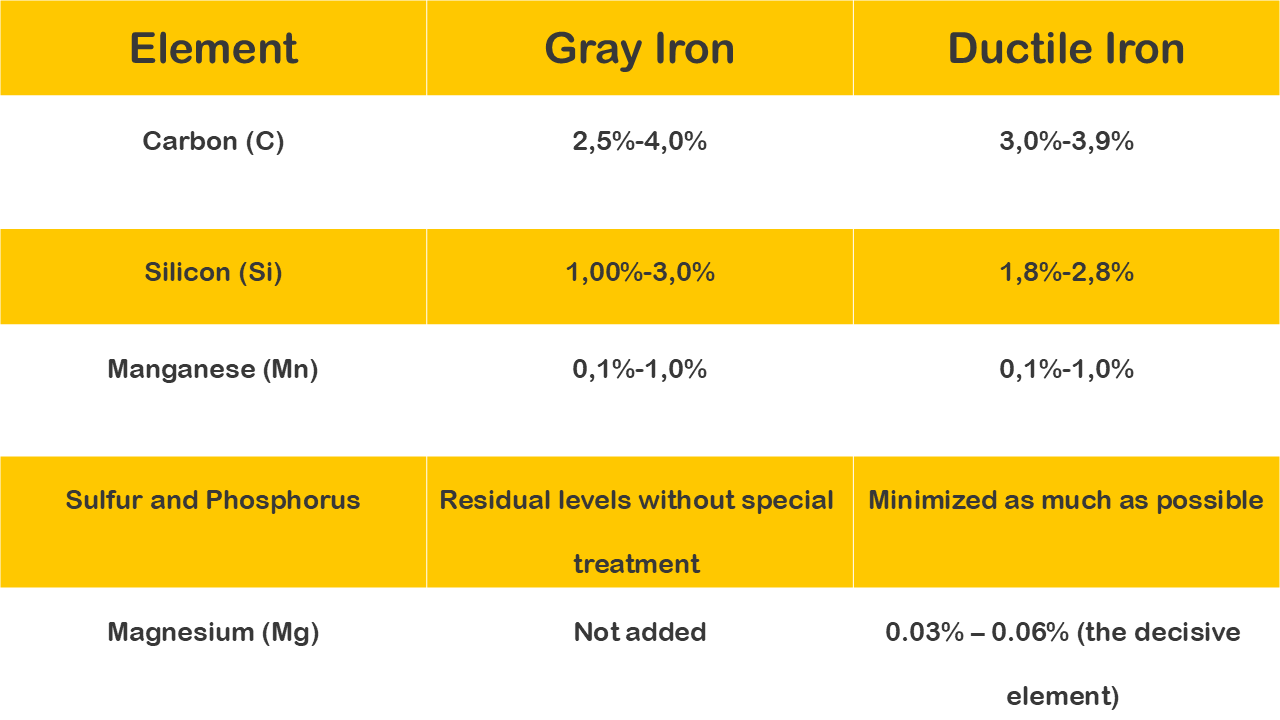
The core difference here is the addition of magnesium (sometimes with cerium as a supporting element) during the final treatment of the melt (inoculation/nodularization) the single step that produces the entire structural difference between the two types.
2. Microstructure: Where the Real Secret Lies
Gray Iron: Flake Graphite
As gray iron solidifies, excess carbon beyond iron's solubility limit precipitates as thin, branching graphite flakes (Flake Graphite – Type A per ASTM A247). These flakes resemble fine cracks scattered throughout the metallic matrix and interconnect in a nearly continuous network along grain boundaries.
The mechanical effect of this shape:
Each sharp tip of a graphite flake acts as a natural stress riser within the structure.
Under tensile loading, microcracks propagate rapidly along these interconnected flakes, leading to brittle fracture with little warning and negligible elongation.
On the other hand, this flake structure gives gray iron two unique advantages: excellent vibration damping capacity, since the flakes dissipate vibrational energy through internal friction, and relatively good thermal conductivity, due to the near-continuous graphite network.
Ductile Iron: Spheroidal (Nodular) Graphite
By adding magnesium to the melt immediately before casting, the surface tension of the solidifying graphite changes dramatically. Instead of spreading as flat flakes, carbon precipitates as discrete, spherical nodules (Nodules – Type VI per ASTM A247).
The mechanical effect of this shape:
The spherical shape has no sharp edges, so there is no severe localized stress concentration as in gray iron.
The nodules are discontinuous from one another, which prevents cracks from propagating easily through the structure.
The result: a structure that behaves mechanically much closer to steel than to conventional iron, while retaining the casting ease and cost advantages of iron.
3. Numerical Comparison of Physical and Mechanical Properties
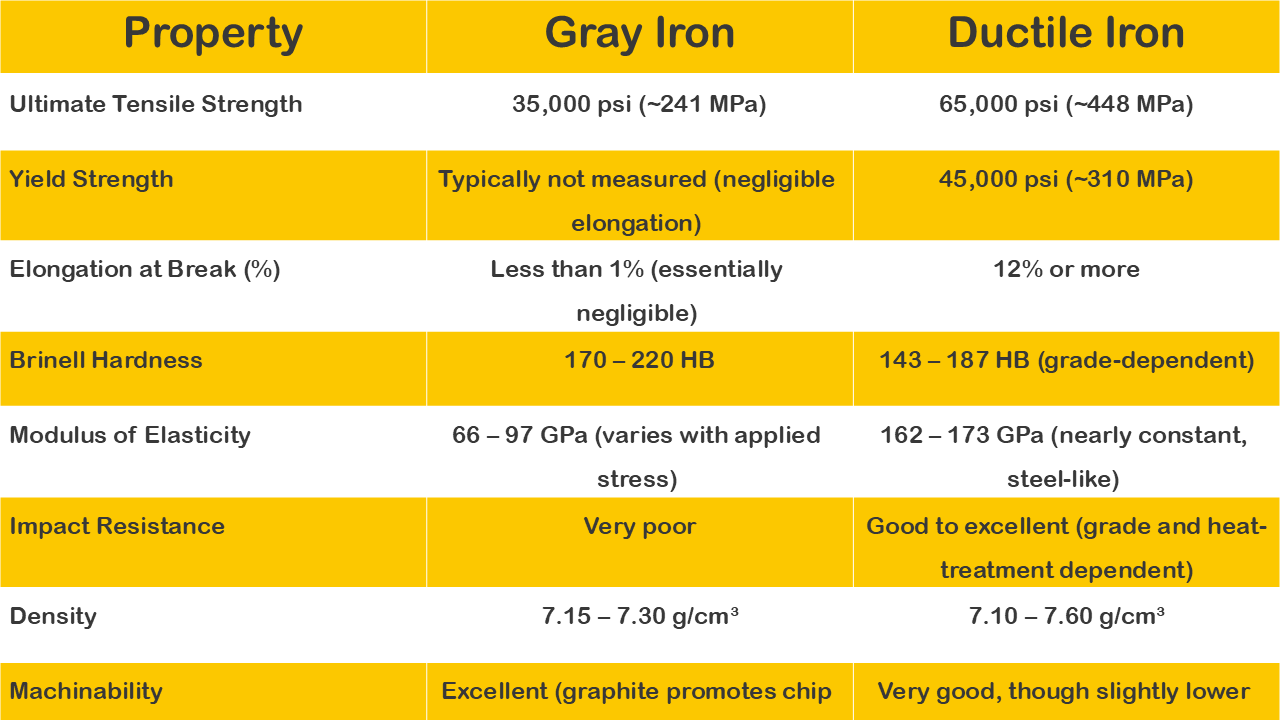
Important note on the modulus of elasticity: Gray iron does not follow Hooke's Law in a perfectly linear fashion its stress-strain curve is nonlinear even at relatively low loads. Ductile iron, by contrast, exhibits a nearly fully linear behavior, much like structural steel.
4. Common Ductile Iron Grades per ASTM A536
Ductile iron is classified using a three-number code that directly describes its mechanical properties:
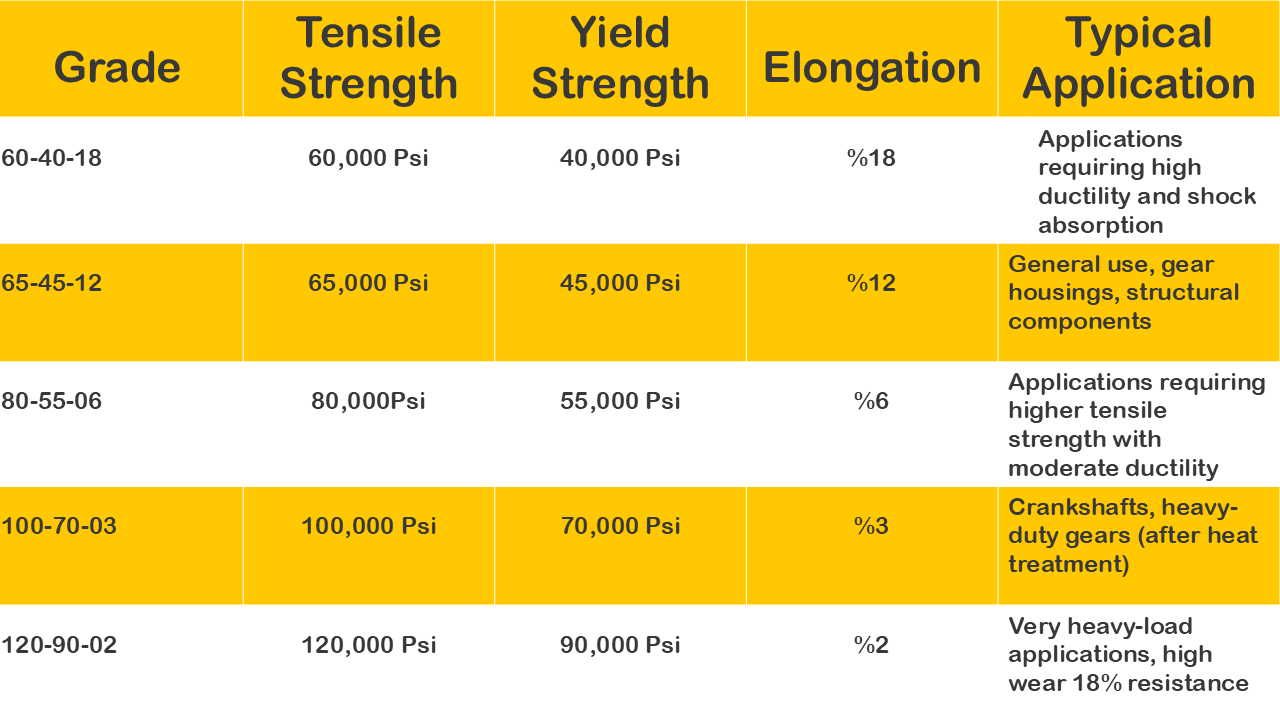
The equivalent European standard (EN 1563) uses codes such as GGG40, GGG50, GGG60, and GGG70, where the number indicates the approximate tensile strength in megapascals.
5. Why Do Castability and Manufacturability Differ?
Gray iron is easier to cast in terms of fluidity and exhibits lower shrinkage during solidification, making it well-suited for complex shapes and large parts such as machine beds.
Ductile iron requires more precise temperature control, careful timing of magnesium addition (since it evaporates quickly), and a secondary inoculation treatment to ensure uniform nodule formation throughout the entire cross-section of the part which slightly increases production cost and complexity compared to gray iron.
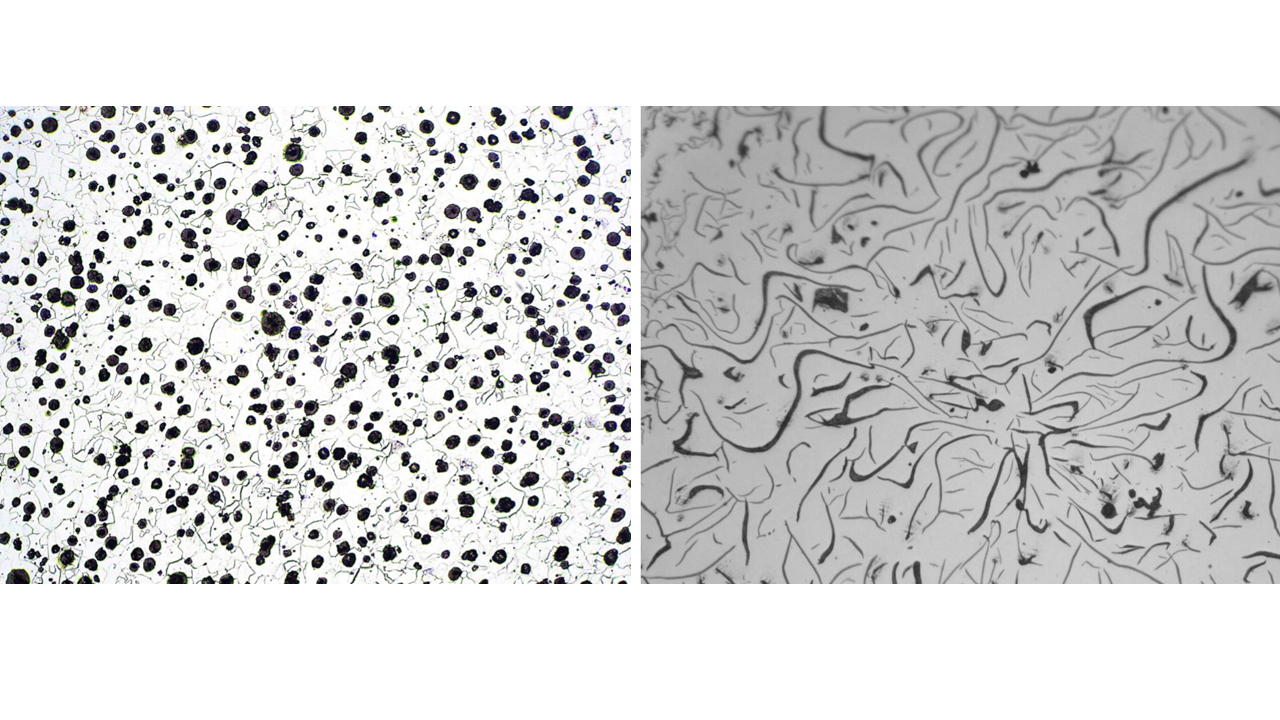
The figure illustrates the difference between two types of cast iron; the right side shows the sharp and brittle graphite flakes of gray cast iron, while the left side displays the isolated, spherical graphite nodules that impart toughness and ductility to ductile iron.
Magnified at 100x
6. Typical Applications for Each Type
Gray iron is well-suited for:
Engine blocks and machine beds (thanks to excellent vibration damping)
Valve covers and components not subject to direct impact
Conventional sewage pipes
Ductile iron is well-suited for:
Crankshafts and moving engine components
Gear housings and moving mechanical components
Structural components subject to repeated shock loading
Economical alternatives to some forged/cast steel applications
Conclusion
The difference between gray iron and ductile iron is not a matter of quality so much as it is a matter of engineering design philosophy. While gray iron offers an excellent economical solution for applications requiring vibration damping and dimensional stability without exposure to sharp impacts, ductile iron provides an exceptional middle ground between the ease and cost advantages of casting and a durability and impact resistance approaching that of steel. Understanding this subtle structural difference rooted entirely in the shape of graphite is what separates a successful engineering decision from a part that fails under the first unexpected shock load.
