
Is Harder Always Better? Choosing Between Gray Iron and Ductile Iron for Your Industrial Project
In heavy industrial casting applications, engineers and procurement managers often fall into a common trap: assuming "harder equals better." The engineering reality is far more nuanced. Choosing the wrong material can lead to premature mechanical failure or, on the other end, to inflated manufacturing costs with no real engineering justification. The right decision isn't about the "strongest" material, but the one best suited to the load type, operating environment, and budget.
In this article, we compare two of the most widely used casting materials in heavy industry: Gray Iron and Ductile Iron (Spheroidal Graphite Iron) to help you make a decision grounded in real engineering data.
1. Gray Iron: Economical, Vibration-Damping, and Excellent Under Compression
Microstructure
Gray iron contains free carbon in the form of graphite flakes distributed within the metallic matrix (ferritic/pearlitic). This flake morphology is directly responsible for the material's characteristic mechanical behavior and also its main weakness: stress concentration at the sharp tips of the flakes.
Key Strengths
Outstanding vibration damping capacity: graphite flakes act as internal dampers that absorb vibrational energy, making gray iron ideal for applications subject to cyclic vibration.
Exceptional machinability: the flakes act as a natural lubricant during cutting, reducing tool wear and improving surface finish.
Very high compressive strength, sometimes 3-4 times its tensile strength excellent for applications where compressive loading dominates.
Lower manufacturing cost compared to ductile iron, thanks to easier casting and machining.
Typical Parts Best Suited for Gray Iron
Pump housings and casings
Machine beds and CNC machine frames
Engine blocks and gearbox covers
Medium-load brake rotors
Low-to-medium pressure pipe flanges (per ASTM A48 / DIN EN 1561)
Industrial counterweights
Reference standard: ASTM A48 (classified by tensile strength: Class 20 to Class 60), with the European equivalent DIN EN 1561 (GJL-150 to GJL-350).
2. Ductile Iron: Tensile Strength and Impact Resistance
Microstructure
The fundamental difference lies in graphite shape: instead of sharp flakes, a nodularization process magnesium addition during casting produces spherical graphite nodules. This spherical shape eliminates the stress-concentration points that gray iron suffers from.
Key Strengths
Significantly higher ductility (elongation can reach up to 18% in some grades, versus less than 1% for gray iron).
Excellent resistance to tensile loading and sudden mechanical shock, making it well suited to dynamic and variable loads.
Superior fatigue resistance without sudden cracking, thanks to the absence of sharp stress-concentration points.
Mechanical properties in some grades approach those of cast steel, at a lower production cost.
Typical Parts Best Suited for Ductile Iron
Industrial valves and valve bodies
High-pressure pipe fittings
Transmission gears and steering knuckles
Crankshafts in certain applications
Heavy equipment and drilling components subject to repeated operational shock
Hub carriers and axle covers in heavy vehicles
Reference standard: ASTM A536 (grades such as 60-40-18, 65-45-12, 80-55-06, 100-70-03), with European equivalent DIN EN 1563 (GJS-400 to GJS-700) and international ISO 1083.
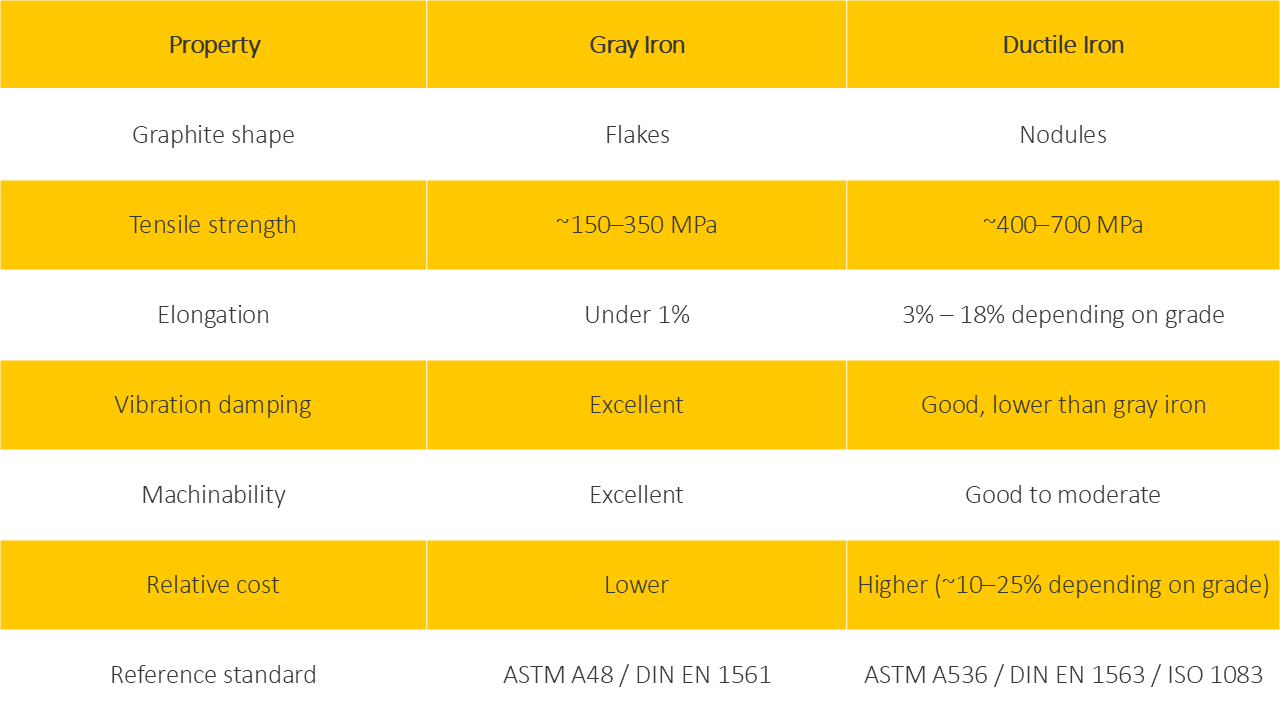
3. Quick Comparison Table
4. How to Make the Right Decision for Your Project
Before submitting a manufacturing order, ask your engineering team these questions:
What's the dominant load type? Steady compressive loading with periodic vibration gray iron is often sufficient and more economical. Variable tensile or shock loading ductile iron is the safer engineering choice.
Is sudden (brittle) failure costly or dangerous in your application? If yes such as with high-pressure valves or safety-critical components ductile iron significantly reduces the risk of sudden cracking.
Can the part be heat-treated or locally hardened instead of switching materials entirely? In many cases, a base gray iron casting combined with induction hardening or localized surface hardening on critical wear zones can be used instead of moving entirely to more expensive ductile iron balancing performance and cost without compromising the part's structural integrity.
What's the operating environment? Temperature, chemical wear, and repeated loading all shift the selection equation and may call for specialized grades of either material (e.g., GJS-500-7 for higher fatigue resistance, or GJL-250 for a good cost-performance balance).
The optimal decision is rarely a complete substitution between the two materials it's usually a deliberate combination of material type, grade, and applied heat treatment.
Need Engineering Consultation for Your Next Project?
Choosing the right material isn't a guess it's an engineering decision based on load analysis, operating environment, and part lifecycle. The VTX Engineering Solutions team brings laboratory capabilities and accumulated expertise (microstructure analysis, XRD, XRF, Spectro, and physical testing) to help you select the optimal material, grade, and heat treatment for your project improving design and reducing production costs.
Contact the VTX Engineering Solutions team today and start your next project on a solid engineering foundation.
